M.S.I.S
the Multi Sensory Information Station
Rethinking the learning experiences in museum in a more physical and educationaly accessible way
Focus
Accessibility
Learning
Pysical interface
Tasks
Research
Workshop design
Prototyping
Usability Testing
2023

Problem
A common issue with museums is that the explanation texts tend to be long and dull, often available in just one or two languages, written in a highly intellectual style, and not fully accessible to meet individual needs.
Regardless of the exhibit itself, further learning and explanations are necessary to fully understand and enjoy the museum. Unfortunately, the information texts often exhaust, confuse, and frustrate many visitors.
PROJECT OVERVIEW :
The Brief
“Das Märkische Museum” (Berlin) approached us to help design the experience for the newly renovated museum. Having been open since 1908, the museum felt outdated, and our primary challenge was:
How can we design the museum of the future?
Personas
The museum chose to work with personas and provided us with one as the focus for redesigning the visitor experience.
Research
We decided to conduct workshops with teenagers who fit the provided persona. We organized two workshops:
1. Online workshop with 9 teens from Sudbury School for Special Needs Education, Israel.
2. In-person workshop with 8 teens and their teachers from Hannah Arendt Gymnasium, Berlin.
Additionally, we consulted with a teacher from Panke Schule in Berlin, a school for students with cognitive disabilities, to better understand their museum field trip experiences.
Conclusions
We gathered all the insights from the workshops and visually organized the data to inform the next steps of the project.
Ideation
After a brainstorming session, we developed several concepts, which we presented to the museum. Together, we refined the ideas down to one core concept.
Prototype
We then created a prototype of the final concept, incorporating both the physical layout and the interactive screen interfaces.
LET’S RESEARCH :
After reviewing the persona provided by the museum, we decided to conduct two workshops with teenagers who aligned with the persona.
The workshops were designed to gather insights directly from the target audience and collaborate with them through brainstorming sessions, simulations and games.
THE PERSONA:
He’s 16 (gen z)
His name is Jakob
Has immigration polish background
Born and raised in the Berlin
Mother language german
Visiting the museum for the first time with friends
WORKSHOPS:

Timetable

Introduction
To help participants feel at ease, we created cultural probs related to both themselves and the museum’s theme as a warm-up activity. With teenagers, it was especially important to create a comfortable environment to encourage them to share their opinions and ideas openly.


Group activity
Together with the museum team the participants placed their opinions about various questions using sticker voting.
Naturally the museum personal and the young participants received different sticker colours.
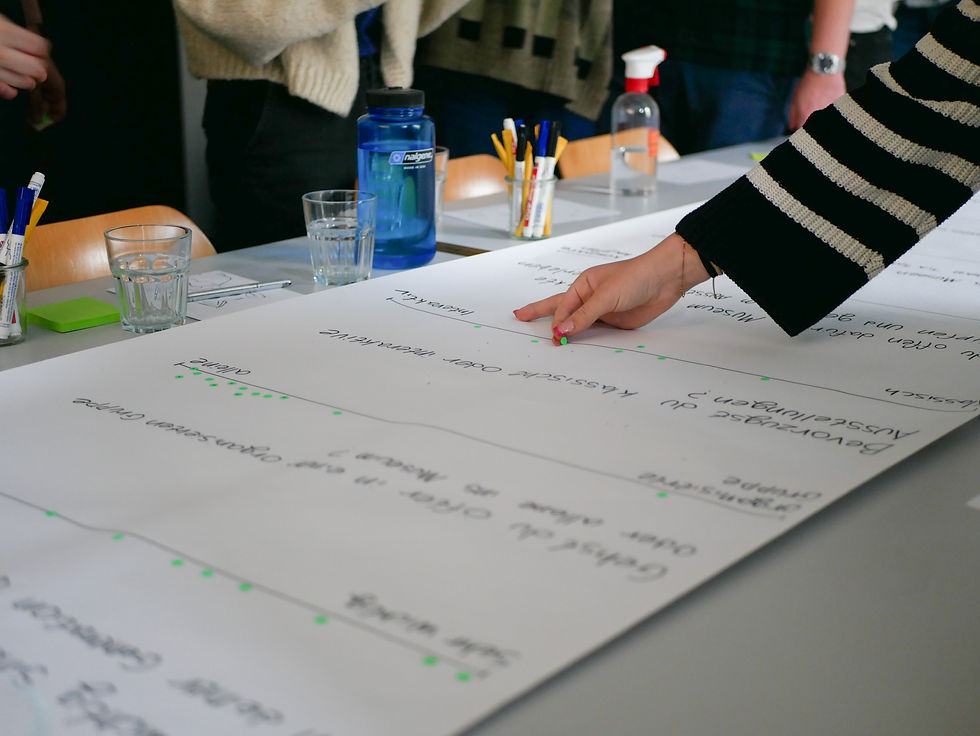

Sticker voting Results
Teenagers
Museum team

The next activity was sticky note brain storming to open questions

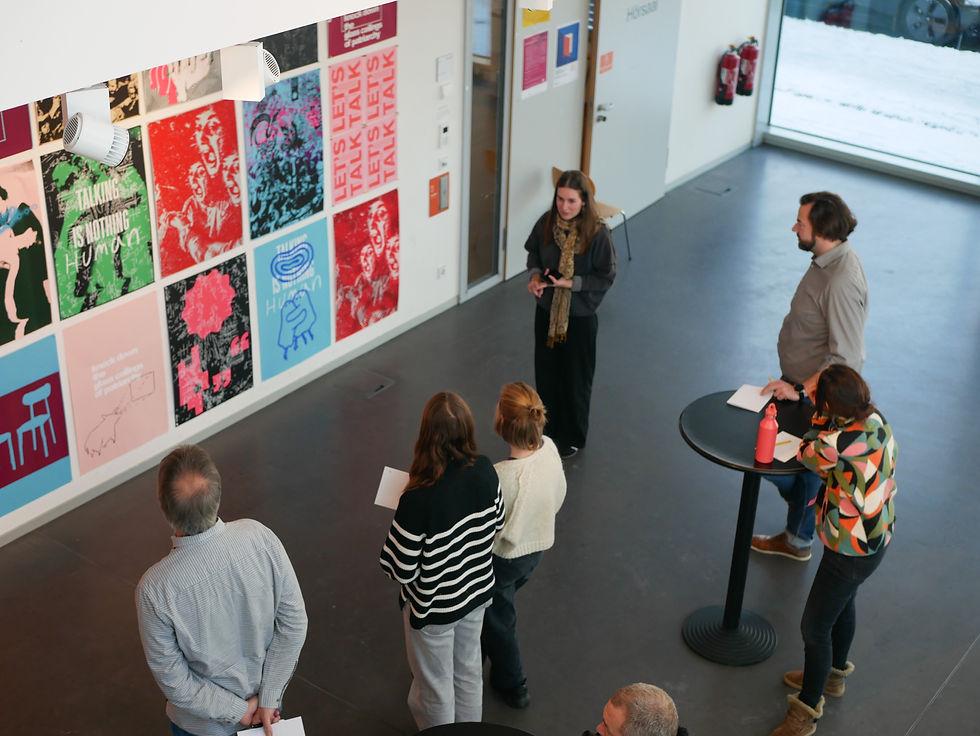
The last activity was body storming, we put the participants physically in a museum situation.
We let them walk around and take notes of things they liked and things they didn’t

We did another online workshop with the special needs school Sudbury school - Israel.
and consulted with a teacher of the cognitive disabilities school Panke Schule - Berlin.
RESEARCH RESULTS:
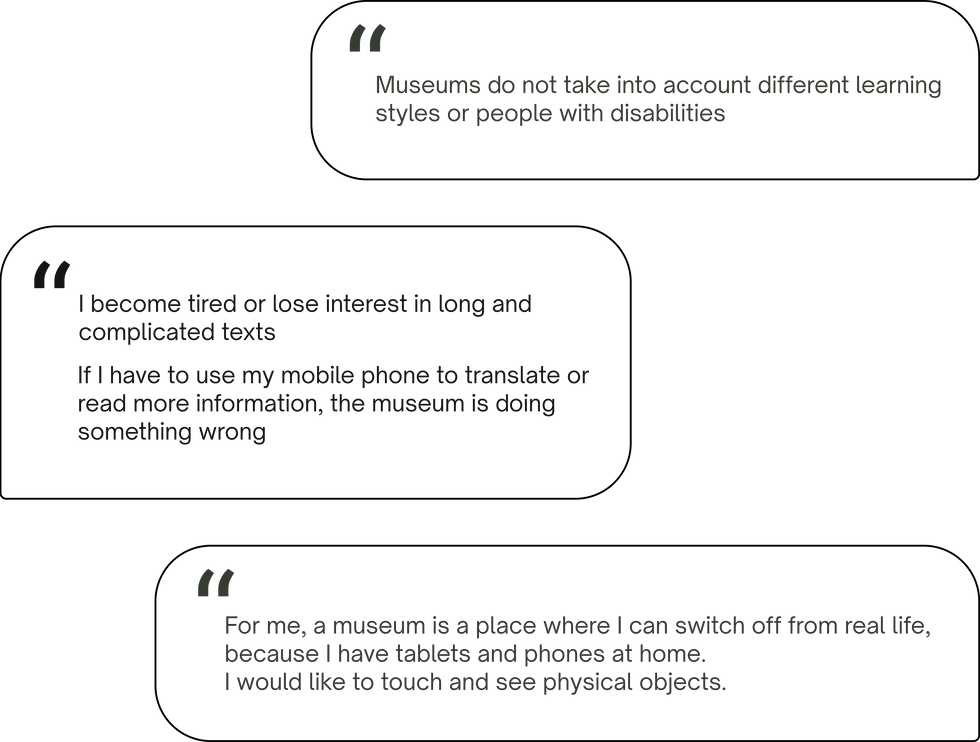
Overlapping Pain points

IDEATION:
Focusing on the research findings, we wrote a theory of change that is mainly addressing the problem of:
Explainer text and information signs
Accessibility
Usability for younger audiences
Physical learning
Our solution

Museums often rely on a single sense to convey information, making them less accessible to all visitors and limiting engagement with the imagination or deeper understanding of the exhibit.
Creating information stations that combine all 3 senses are an accessible solution for information around the museum.
Multi-sensory Information stations will not only make the information and the text accessible for visitors with different physical and cognitive needs but also will make the learning and discovering more intriguing and interesting to all visitors

combinations of at least two senses will also work when it’s impossible to connect all senses

Museums often rely on a single sense to convey information, making them less accessible to all visitors and limiting engagement with the imagination or deeper understanding of the exhibit.
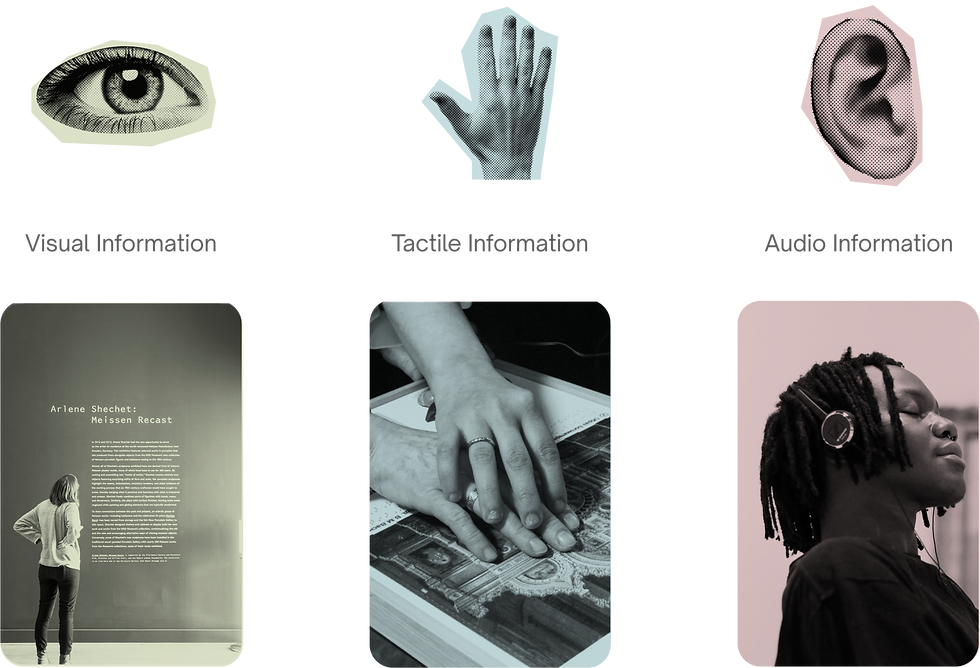
Our solution
Creating information stations that combine all 3 senses are an accessible solution for information around the museum.
Multi-sensory Information stations will not only make the information and the text accessible for visitors with different physical and cognitive needs but also will make the learning and discovering more intriguing and interesting to all visitors

combinations of at least two senses will also work when it’s impossible to connect all senses
SUMMARY AND RETROSPECTIVE:
After a few successful workshops and a lot of research on the subject of accessibility and learning methods I gathered few points to keep in mind when working again on a similar projact:
Design with the audiance
One key takeaway from this project is the importance of designing with the audience, not just for them. While we made great efforts to engage our target audience through workshops and feedback sessions, working on accessibility and inclusiveness requires an even greater level of sensitivity and consideration. It’s crucial to ensure that all possible users—especially those with diverse needs—are actively included in both the research and design processes. By collaborating directly with a wider range of users, we can create solutions that truly reflect their perspectives and provide meaningful, inclusive experiences for everyone.
What you feel and what you say
When conducting workshops and interviews with younger audiences, we noticed a gap between what participants said and what they truly thought. Many teenagers seemed to tailor their responses to what they believed we wanted to hear or to appear a certain way in front of peers.
Creating a comfortable, judgment-free environment was key to encouraging genuine feedback. By fostering openness and trust, we were able to gain deeper insights into their true experiences and perspectives.
Insights from Body storming
When designing physical interfaces or user experiences, bodystorming proved to be an invaluable research tool. By placing participants in the actual physical situations we were exploring, we uncovered new insights that didn’t emerge during theoretical brainstorming sessions.
This hands-on approach allowed us to observe real-time reactions, behaviors, and challenges, providing a deeper understanding of user needs and preferences. The quality of insights gained through bodystorming highlighted the importance of grounding research in real-world experiences.
Thank you for reading
THE STATION:
